


Bartlett, S. (Host). (2025, July 3). World expert on fatherhood & love: The truth about monogamy, breakups & the science of love! [Video]. YouTube. Link
AND ORS © 2025
All rights reserved
There’s a particular kind of electricity in a teenage crush: The rush in your chest, the sweat in your palms, the slowing of time, and the sudden awareness of your every move. I had my share of crushes, from the dreamy Leonardo DiCaprio in Titanic (I had a huge poster of him above my bed) to the boy next door, the one I’d pass each morning on the school bus. I lived for those mornings. I’d make sure he caught me looking, and our eyes would meet for a split second, followed by that barely noticeable head turn, a turn enough to know the eye contact was mutual. Most of my crushes weren’t reciprocated, and in those moments, I always wished for a love potion powerful enough to make them feel the same.
Today, even though the science of love is still complicated, it’s believed that maybe (just maybe) we’re getting closer to actually creating that love potion. Recently, I came across an episode of The Diary of a CEO podcast 1, and this part stuck with me:
“So we kind of probably know just about enough about the neuroscience of love now, particularly neurochemicals, which underpin it, that should we wish to, we could finally produce the elixir of love.”2 — Anna Machin (Bartlett, 2025, 1:30:26)
Anna Machin, a British evolutionary anthropologist from Oxford University’s Department of Experimental Psychology and guest on this episode, mentioned how there are loads of ancient writings of potions that supposedly make you fall in love. It’s something humans have always wanted – maybe because love is uncertain, unpredictable and uncontrollable, and we just can’t handle that. 3
Feelings of love are among the most powerful and fundamental experiences we humans go through. 4 Love shapes how we form deep connections, whether it’s the bond between partners, between parents and their children, or even the way we relate to friends, strangers and the world around us. 5 It’s the invisible thread that holds so many parts of our lives together, guiding how we connect, care, and belong.
In this Part 2 of the #People series, we touch upon the biology and evolution of love and how they shape the ways we visually express and perceive this emotion. We’ll also look at how fear and love can intertwine, both in life and in the visuals our reactions, actions and interactions create.
An illustration of a love potion bottle.
When you look up the definition of love, you’ll find a few different versions. The dictionary describes it as: 1) Strong affection for another, born out of kinship or personal ties (parental love), 2) Attraction based on sexual desire, affection and tenderness felt by lovers (romantic love), 3) Affection built on admiration, kindness, or shared interests (friendship). 6 These types of love are universal.
But when you dig into the biology of this emotion, it’s clear how complex it gets. Love is like a dish made of many other emotions – trust, empathy, joy, lust, grief, warmth, pain – blended together in different amounts depending on the type of relationship, the people involved, upbringing, and culture.
“Love is a complex neurobiological phenomenon, relying on trust, belief, pleasure and reward activities within the brain[...].”7 — Esch & Stefano
The Neurobiology of Love, a prominent academic paper by Tobias Esch and George B. Stefano, shows that whether it’s passionate, parental, friendly, or altruistic love, it comes from the interaction of chemical and hormonal families, each uniquely contributing to the experience and expression of love. For instance, in romantic and parental love, the process can happen in the following (but not necessarily the same) stages: it starts with attraction and lust, then moves to attachment, bonding, and commitment. 8 Each of these stages, different hormones and chemicals play bigger or smaller roles. This shows how – fundamentally – love depends on hardwired neurochemical and brain systems, making it biological (and universal) at its core.
However, not all behaviors are natural. They are also intertwined in the nurture part of love. Love is not uniform. Individual differences, upbringings, environments, cultures and other social factors, influence how love may be felt and/or expressed. This includes learned attachment styles, personal values, and the influence of family and religious/non-religious backgrounds, which shape the biological blueprint. If we take the example of parental love in early life, parent-child interactions are critical, as hormonal exposures can change how love and attachment are expressed later, when the child reaches adulthood. Exposure to stress hormones before or after birth, as well as the developmental experiences during parent-child interactions, can affect patterns of social and sexual behaviors later in the child’s life. 9 Other studies take it further by stating that some of these might be passed down as gene changes to future generations. 10 (Studies also recognize that gene alteration is complex, context-dependent, and still not fully understood in humans).
When it comes to design solutions, whether spatial, digital, or any other medium, we need to pause… and look into the factors that might affect pregnant women or breastfeeding mothers. What kind of environments and experiences should they be surrounded by? And if we’re designing for a kindergarten or playground, how can we create an optimal space that brings safety, care and belonging for the children, while reducing stressors or other negative stimuli that could have long-term effects? Because, while love depends on innate neurobiology, its form, sensitivity, and expression are deeply shaped by acquired experiences, from early in life and throughout ongoing social interactions. Love is plastic: it is a product of ‘nature’ and ‘nurture’ working together to shape it – and shape us – with the possibility that ‘nurture’ may, over time, become ‘nature’ in the evolution of humanity.
A diagram of sliders representing different 'love chemicals' (dopamine, oxytocin, serotonin, etc.) arranged as if they were on a mixing board. It’s a simple, symbolic illustration meant to convey the idea of love as a mix of brain chemistry, not a scientific measurement of actual levels.
Cultural norms play a big role in how love is visually communicated – through facial expressions, physical gestures, symbols, or public displays. These norms also shape how relationships are structured. For example, in The Evolution of Love in Humans, David M. Buss, professor of psychology at the University of Texas at Austin, notes that cultures vary widely in how relationships are structured: some favor arranged marriages, while others promote “love” unions where individuals choose their partners. 11 Rules around fidelity, polygamy, and public affection differ as well. 12 These cultural and evolutionary layers don’t just affect who we love, they influence how love is visualised, expressed and perceived in everyday life.
In traditions where restraint is valued, love is expressed quietly: a gentle touch, a fleeting glance, or what some call ‘soft eyes’, rather than obvious smiles with prolonged eye contact. In others, love is more openly displayed: smiling, direct eye contact, and expressive faces and postures openly signaling attraction or desire. Public affection follows the same pattern. In many Western countries, hugging, kissing, and holding hands are common and socially accepted, openly communicating romance and intimacy. 13 Whereas in parts of Asia or the Middle East, love is often shown through gestures and meaningful acts, like preparing a special meal to your loved one or cooking together. 14 Gift-giving is another visual expression of love. In the West, a bouquet of red roses might say “I love you”. In South Korea, couples wearing matching outfits signal their relationship without a public kiss. 15
Parental love also varies across cultures. In the West, parents may repeatedly hug their children or say “I love you” to show warmth. In many Asian cultures, affection is expressed through providing food, shelter, education, and ongoing support. 16 Even the way children are disciplined varies: in some cultures, parental authority is reinforced with a serious, unsmiling face and intense eye contact to show seriousness. In others, parents emphasize negotiation and autonomy like listening with a soft or neutral expression, steady but non-threatening eye contact, or nods and head tilts to communicate encouragement and acknowledgment of the child’s perspective. 17
The point is, love doesn’t have to look like the Western version we see in movies to be real or deeply felt. Around the world, there are countless ways to show love. This has to be considered when designing for a culture different from our own. For example, a campaign showing romantic or parental love should adapt its visuals to fit local norms. A photo of a public kiss might resonate in one country but be rejected as inappropriate in another. A shy, lingering gaze might be understood in one culture but go unnoticed in places where love is expected to be expressed openly and explicitly.
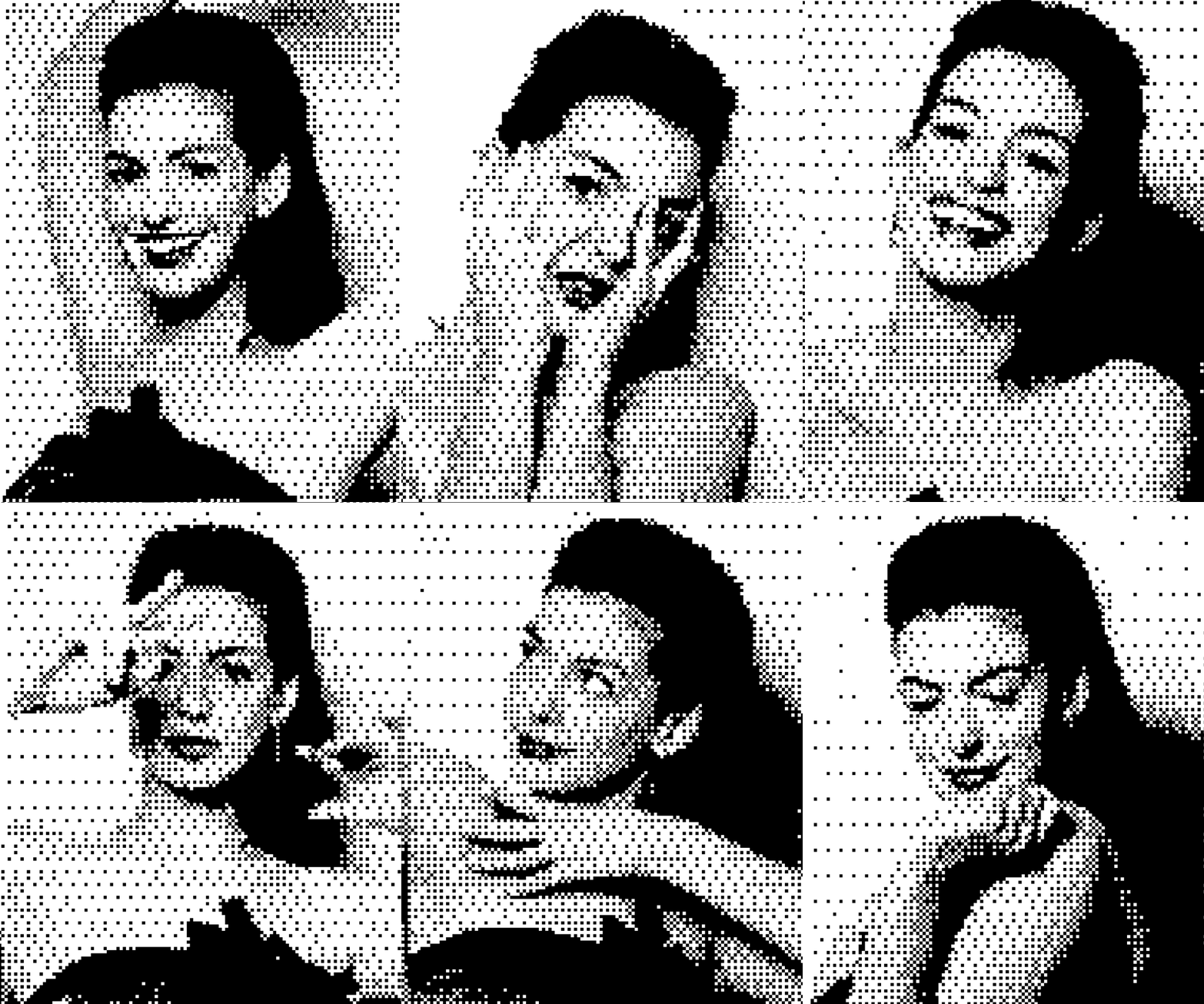
A visual representation of a woman clearly expressing a wide range of positive emotions.
Both fear and love share common evolutionary roots and are involved in survival and the evolution of our species. In their paper Love and Fear: A Special Issue, Carter and Dantzer point out that we live in a world full of dangers and uncertainties, and that feeling fear helps us stay safe by preparing us to react to threats. 18 However, if fear lasts too long or is too intense, it can become overwhelming and harmful to our health and well-being. Because life can be so stressful, humans and many animals have evolved to rely on each other. 19 Being connected with others helps us handle stress better, and this social support improves our chances of survival and longevity. At the heart of these social connections is what we now call ‘love’. 20
One powerful and natural experience where fear and love intertwine happens during the attachment and bonding phase, when a couple becomes parents for the first time. A hormone called vasopressin – among others, like oxytocin and cortisol – is released, helping parents stay alert and ready to protect their child from danger. This response reflects both fear, in the worry for their child’s safety, and love, in the deep affection and care they feel. 21 An image depicting a parent and child in a dangerous situation can similarly trigger threat and affection. Early attempts to get computers to predict human emotions from images tried to label them as distinct categories (happiness, sadness, fear, etc.), but researchers found this approach limited, as real human emotions are often mixed, layered, or overlapping, making strict categorical separation difficult for computation to achieve. 22
People also respond very differently to the same situation or visuals. For example, jumping off a cliff might terrify one person but thrill another, or viewing a portrait could evoke love, affection, or nostalgia in one person while triggering fear or disgust in someone else. 23
People are also skilled at interpreting others’ emotions through facial expressions and body language. 24 An affectionate smile can encourage approach, while an angry stare often triggers avoidance, confusion, or fear. We open our arms to embrace a loved one after a long separation, or push someone away when we feel threatened or scared. However, this is not always accurate, as postures can be misinterpreted. For example, a person stretching their arms may not be signaling affection, or someone retreating with a shocked expression might just have remembered they left their cellphone at home.
In the end, these observations reveal just how complex the human emotion and its visual interpretation is. A single visual can stir multiple, overlapping feelings in one person (including fear and love), while the same image can make one person feel love and the other feel fear. And yes, we are often able to read emotions from faces and body gestures, but we are far from being 100% accurate all the time. This highlights the fact that feeling the emotions, understanding them within ourselves, and/or interpreting other people’s situations or expressions is rarely straightforward, and accuracy depends on intentions, conscious and subconscious feelings, past experiences, and cultural context.
A visual representation of the infamous door prop that kept Rose (but not Jack) afloat in Titanic. The scene captures the intertwined emotions of Fear and Love.
Bartlett, S. (Host). (2025, July 3). World expert on fatherhood & love: The truth about monogamy, breakups & the science of love! [Video]. YouTube. Link
Bartlett, S. (Host). (2025, July 3). World expert on fatherhood & love: The truth about monogamy, breakups & the science of love! [Video]. YouTube. Link
Bartlett, S. (Host). (2025, July 3). World expert on fatherhood & love: The truth about monogamy, breakups & the science of love! [Video]. YouTube. Link
Rinne, P., Lahnakoski, J. M., Saarimäki, H., Tavast, M., Sams, M., & Henriksson, L. (2024). Six types of loves differentially recruit reward and social cognition brain areas. Cerebral Cortex, 34(8), bhae331. Link
Rinne, P., Lahnakoski, J. M., Saarimäki, H., Tavast, M., Sams, M., & Henriksson, L. (2024). Six types of loves differentially recruit reward and social cognition brain areas. Cerebral Cortex, 34(8), bhae331. Link
Love. (n.d.). In Merriam-Webster.com dictionary. Retrieved August 11, 2025. Link
Esch, T., & Stefano, G. B. (2005). The neurobiology of love. Neuroendocrinology Letters, 26(3), 175–192. PMID 15990719.
Esch, T., & Stefano, G. B. (2005). The neurobiology of love. Neuroendocrinology Letters, 26(3), 175–192. PMID 15990719.
Esch, T., & Stefano, G. B. (2005). The neurobiology of love. Neuroendocrinology Letters, 26(3), 175–192. PMID 15990719.
Liberman, N., Wang, S. Y., & Greer, E. L. (2019). Transgenerational epigenetic inheritance: From phenomena to molecular mechanisms. Current Opinion in Neurobiology, 59, 189–206. Link
Buss, D. M. (2018). The evolution of love in humans. In V. Zeifman & D. M. Buss (Eds.), The evolution of sexual morality. Cambridge University Press. Link
Buss, D. M. (2018). The evolution of love in humans. In V. Zeifman & D. M. Buss (Eds.), The evolution of sexual morality. Cambridge University Press. Link
Sorokowski, P., Sorokowska, A., Hilpert, P., Cantarero, K., Frackowiak, T., Ahmadi, K., ... & Pierce, J. D. (2017). Cultural differences in greetings: The role of touching in physical contact in greetings across cultures. Journal of Nonverbal Behavior, 41(4), 341–357. Link
Rothbaum, F., & Tsang, B. Y. (1998). Love songs in the United States and China: On the nature of romantic love. Journal of Cross-Cultural Psychology, 29(2), 306–319. Link
Yoon, K. (2019). Love in contemporary South Korean culture. Routledge. Link
Rothbaum, F., Weisz, J. R., Pott, M., Miyake, K., & Morelli, G. (2000). Attachment and culture: Security in the United States and Japan. American Psychologist, 55(10), 1093–1104. Link
Chao, R. K. (1994). Beyond parental control and authoritarian parenting style: Understanding Chinese parenting through the cultural notion of training. Child Development, 65(4), 1111–1119. Link
Carter, C. S., & Dantzer, R. (2022). Love and fear: A special issue. Comprehensive Psychoneuroendocrinology, 11, 100151. Link
Carter, C. S., & Dantzer, R. (2022). Love and fear: A special issue. Comprehensive Psychoneuroendocrinology, 11, 100151. Link
Carter, C. S., & Dantzer, R. (2022). Love and fear: A special issue. Comprehensive Psychoneuroendocrinology, 11, 100151. Link
Esch, T., & Stefano, G. B. (2005). The neurobiology of love. Neuroendocrinology Letters, 26(3), 175–192. PMID 15990719.
Wang, J. Z., Zhao, S., Wu, C., Adams, R. B., Jr., Newman, M. G., Shafir, T., & Tsachor, R. (2023). Unlocking the emotional world of visual media: II. Emotion: The psychological foundation. Proceedings of the IEEE, 111(10), 1236–1286. Link
Wang, J. Z., Zhao, S., Wu, C., Adams, R. B., Jr., Newman, M. G., Shafir, T., & Tsachor, R. (2023). Unlocking the emotional world of visual media: II. Emotion: The psychological foundation. Proceedings of the IEEE, 111(10), 1236–1286. Link
Wang, J. Z., Zhao, S., Wu, C., Adams, R. B., Jr., Newman, M. G., Shafir, T., & Tsachor, R. (2023). Unlocking the emotional world of visual media: II. Emotion: The psychological foundation. Proceedings of the IEEE, 111(10), 1236–1286. Link


