

Johansson, B. (2011). Attention and the von Restorff effect. British Journal of Psychology, 61(2), 163–170. Link
AND ORS © 2025
All rights reserved
It’s quite amazing how a symbol can stand the test of time. Through all the evolution in our humanity, all the technology, all the wars and disasters – natural or human-made – a symbol can persist, and continue to transcend generations.
Given a symbol’s enduring presence, how do novel and familiar interpretations of it shape our visual culture and affect the people within it? How does a symbol’s presence in various contexts influence the appeal of the familiar versus the novel? This article will examine Christianity and the cross as a central symbol, exploring its evolution through time, space, and mediums.
In previous articles, we touched on many key points around novelty and/or familiarity – from case studies to perspectives, lived experiences, and psychological theories. We explored the isolation effect 1, where contrast draws our attention and stays in our memory. We also looked at the mere exposure effect 2, and how what we see, feel, smell, or experience regularly can grow on us and become something we enjoy and admire. We talked about how a person’s emotional state, at a given moment, can shape their preference for novelty or familiarity 3. In business and innovation, we saw that finding the right balance between the two often leads to success. We also observed how familiar artifacts, even those tied to painful memories, can be embraced and fiercely defended by a society.
These psychological dynamics manifest across various visual aspects of our culture, which collectively form what we call visual culture. Visual culture is defined as the visual objects and practices produced during a specific time period, including art, architecture, theater, film, public spaces, and more 4. Throughout this issue, we have focused on people, brand, architecture, and digital. Visual culture is all of those, and much more – a term defined by scholar and art historian Alexis Boylan 5 in her book, Visual Culture 6. It’s how people perceive, understand, feel, act, react, and interact with their visual environment.
“Visual environment is the sum total of the visual objects that surround us” —Alexis Boylan 7
Visual environment is made up of all the things we see around us, and the ways they can shape our identities, influence our beliefs, and ultimately compel us to communicate visually using the codes and symbolic languages that are shared by individuals in a particular group, community, society and culture. In other words, it's about how visual objects are communicated and interpreted within a given culture. These interpretations shift from one culture to another, from one community to another, from one group to another, and from one individual to the next. The visual objects can range from mere decorative artifacts to symbols of power and ideology, evolving into sacred symbols worn on our bodies (necklaces, tattoos, crowns, etc.). They can take on such significance that they seem to have a soul of their own – untouchable, something you cannot offend, or else conflicts may break out if you do.
Today, Christianity is the most followed religion on earth. This religion has been fragmented, reinvented, resurfaced, reinterpreted. And the gospel continues.
In most Christian churches, the cross is the central symbol. In many traditional churches, the cross is supported and surrounded by artistic ornamentation and iconography – sculptures, murals, stained glass, etc. Other Christian churches reject the glamour and decoration surrounding it, focusing instead on simplicity and humility.
The design of the cross has continuously shifted throughout time and across churches. Yet, no matter how many ways it has been reimagined, its core remains unchanged: two simple intersecting lines, one vertical, one horizontal, meeting slightly above center.
I remember my father driving me to school when I was very young. Every morning, we’d pass a narrow valley road, and at the rounded corner stood a small shrine, about the size of a tiny room with a low ceiling. Each time we passed, my father would gesture the cross – touching his forehead with his right hand, then moving it down to his chest, and across to his left and right shoulders. After witnessing this a few times, I asked him why he made this sign every time we passed this shrine. He replied, “It’s a sign of respect to God, and for Him to protect us on these slippery roads”. From then on, I started making the sign of the cross every time we passed a shrine, a church, a cemetery, or any piece of wood that resembled a cross.
The foundation of this symbol – the two simple intersecting lines – whether visual or gestural, has become a shared familiarity for billions of believers and non-believers of the Christian faith. Even across the various branches of this religion, it remains a shared anchor in belief and visual identity, transcending race, language, and environment. Novelty here translates into its evolving forms and expressions – the different visual interpretations of the cross, and the layering of other symbols and scenes around it. Some embrace the novel, adding visual elements to the cross as a way of offering God their time, patience, talent, and craftsmanship. Others may prefer the traditional and familiar, keeping it simple and focusing on prayer and quieter practices. These changing contexts continuously reframe how the familiar symbol is expressed (or not) in novel ways.
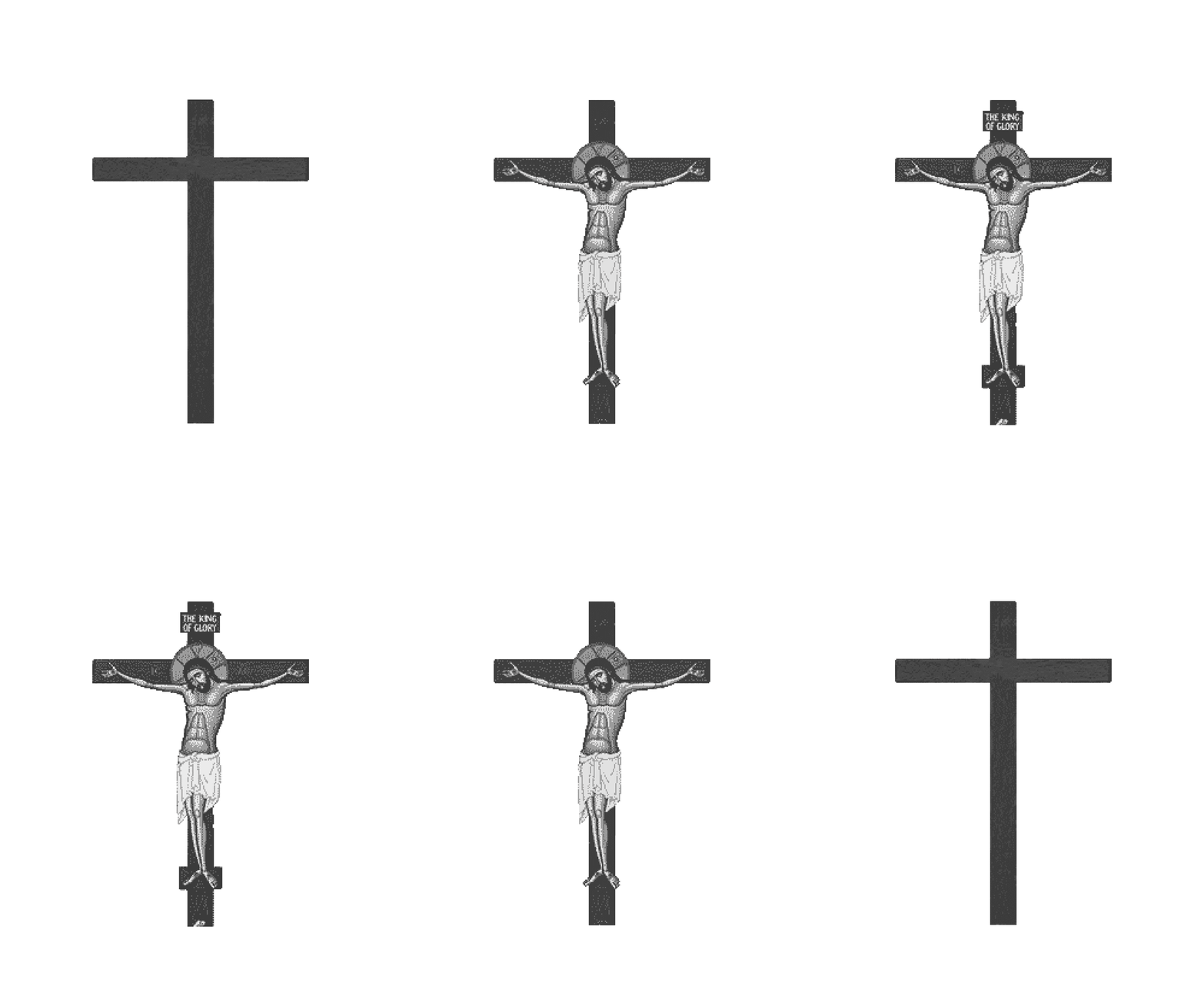
An animation representing the Byzantine-style cross, breaking it down into its different elements to show the transition from a simple, familiar form to a more decorative and ornamental style that can vary from one church to another.
I was raised in a Catholic household in Lebanon, where religion wasn’t just a belief system, it was a lifestyle and identity. After moving to Denmark, I found myself fully atheist. But the shift didn’t happen overnight, it began quietly, a few years before I left for Europe. In 2011, I started actively questioning God’s existence, though, passively, the doubt had been living in me much earlier. I began pulling at the threads of doctrine that had shaped so much of me. Later in 2014, I went to a vernissage in Barcelona, where the artist’s entire painting collection was centered on Jesus and the cross. Beautiful, intricate works, framed with irony, philosophy, and sexuality. But for someone raised like me, these paintings were also a bit offensive, despite my growing detachment from faith. It felt as if those images were mocking my people, my family, my whole past existence.
God and sex. The holy and the sinful. That kind of visual tension felt like a forbidden thought I used to push out of my mind. Something I’d catch myself thinking, then immediately silence with a prayer, or a gesture of the cross. And now, there it was, fully formed, hanging on a gallery wall, out in the open for anyone to contemplate.
Another experience that comes to mind is one of those cross-cultural moments that happen within the same city, among people of the same nationality. As many know, Lebanon is a sectarian country, with a mix of Christians, Muslims, and Druze. It's like living in different cultures within the same space. It is quite charming, yes, but also complicated.
I remember the first time I visited a part of Beirut that was predominantly Muslim. To my surprise, I saw a few young men walking around wearing cross necklaces. It confused me a bit. When I asked a friend why Muslims would wear crosses, the response was: “Some people wear the cross to pass as Christian, either for social reasons, work, or other motives”. That small silver necklace could completely change how people were perceived and treated. Writing this now, I feel a mix of anger and shame. Being Christian in Lebanon,and signaling that with a cross, has always been a privilege. It’s a disappointment to think that some felt the need to wear this symbol just to avoid discrimination in parts of the country where they would be seen as 'the other'.
The novelty and/or familiarity of the cross in visual culture doesn’t just shift over time, the contrast is also felt across regions, sometimes even within areas that are geographically close but culturally somewhat distant. Again, a simple shape – two intersecting lines – when interpreted in a way that deviates from its traditional religious meaning, especially when associated with something considered 'sinful' or worn by someone outside the faith it represents, reveals just how loaded and flexible a symbol can be. Its meaning shifts depending on where, how, who, and why it’s used – crossing doorsteps, streets, and even national borders.
A representation of a cross necklace commonly worn by men in religious regions of certain countries.
In pop culture, the cross has been reinterpreted in countless ways across various mediums. From media platforms to everyday objects, its role changes depending on the context and the boundaries that define it. Well, in today’s world of the internet and social media, physical boundaries have become less significant. We now come across these visuals digitally daily, and the only remaining 'boundaries' are our personal values and convictions.
The cross has taken on controversial meanings in various entertainment fields. In fashion, it’s a bold statement: oversized, glamorous, sparkling with diamonds. It has shifted from a symbol of faith to one of status. In music, particularly in heavy metal and punk, it became even more charged. You see it in music videos, face paint, earrings and leather jackets – sometimes flipped upside down, a reference to the anti-Christ, intended to provoke and blur the line between the sacred and the profane. When someone raises a cross upside down, they’re instantly associated with devil worship – at least, that’s how I remember it being portrayed in the news back in the 90s.
The cross now serves many purposes: from blessing you with holy water to popping open a bottle of champagne. In Christian homes in Lebanon and other countries with deep Christian roots, the cross is everywhere: on the wall, on the dinner table, as a magnet on the fridge, blessing everything it touches. In Danish secular households, the cross might be displayed alongside a Buddha statue and the Arabic word “Allah,” all three side by side. Is it a gesture of inclusion? Or simply a souvenir from a country they visited?
The evolution of this symbol is ever-changing, its meaning is shaped by the context in which it appears. The details matter: whether it’s placed in the background or foreground, its size, the sharpness of its edges or three-leafed design, the angle it takes, who is wearing it – is it the Pope or is it Lady Gaga? The cross has been reinterpreted time and again, sometimes stirring scandal, sometimes evoking devotion, but always mirroring the broader cultural debates of the time. It’s a symbol that, like us, changes with us and our surroundings, constantly playing between the sacred and the secular.
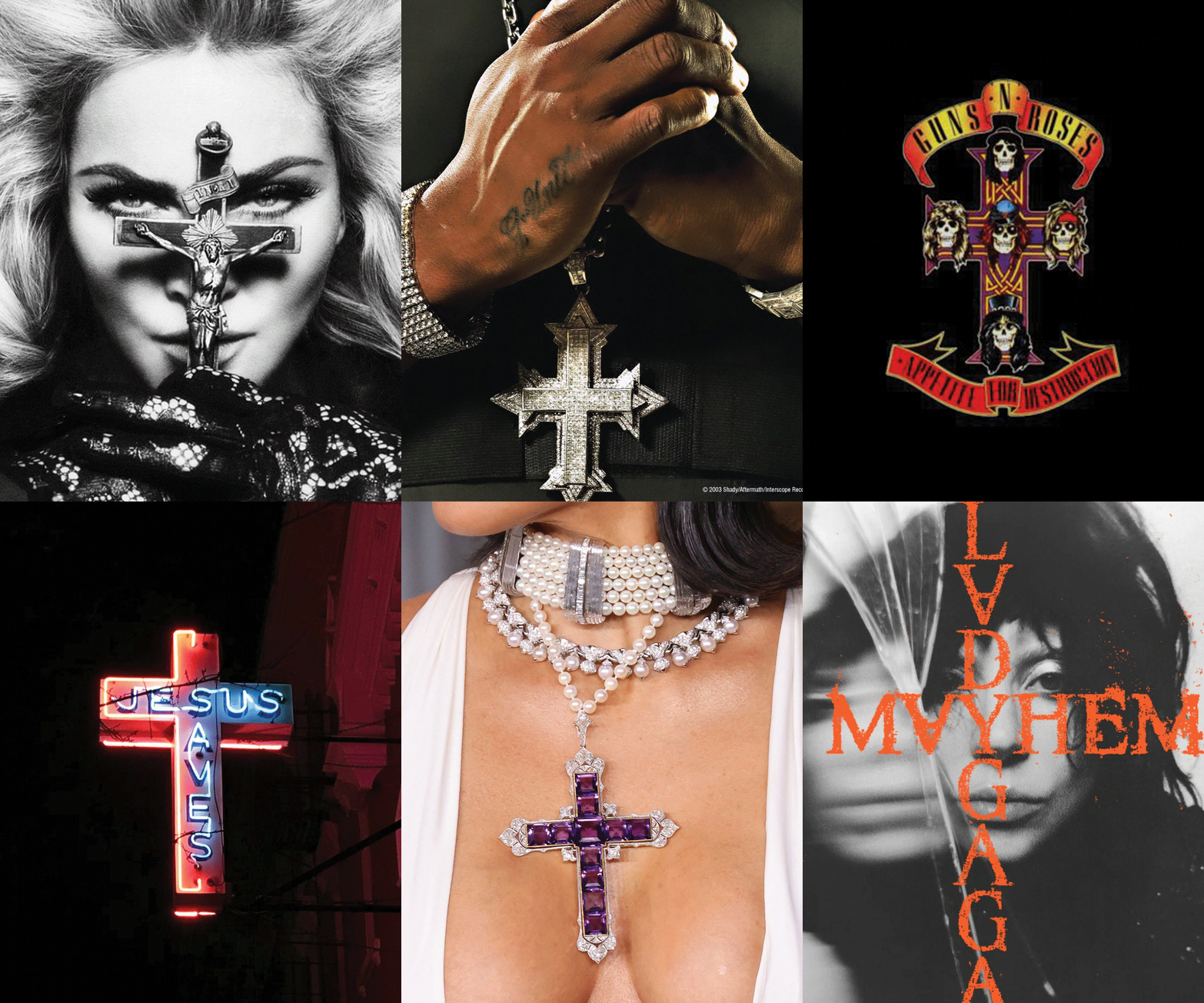
A collage showing the various ways the cross is worn, used, and illustrated across different genres of entertainment as well as in religious contexts.
The cross continues to evolve in meaning depending on its context. Whether in minimalist churches or reimagined in pop culture and media, its visual interpretations highlight the tension between the novel and the familiar – familiarity being grounded in its religious foundation. Yet, no matter how or where it’s worn, styled, or positioned, it always returns to the same core: the familiar, quietly anchored in tradition as it shifts across time, borders, and cultural moments.
Familiarity, in many ways, is a pillar of our humanity and evolution. A gateway to the new, it offers a starting point, and helps something novel catch on, until the novel itself becomes just another familiar. All in all, familiarity plays a foundational role in how we understand, perceive, use, and build both personal and collective identities. Novelty, on the other hand, is more like a spice, something to keep us curious and on our toes.
I wonder: will there come a time, where a symbol this powerful feels totally novel to a future generation?
Johansson, B. (2011). Attention and the von Restorff effect. British Journal of Psychology, 61(2), 163–170. Link
Zajonc, R. B. (1968). Attitudinal effects of mere exposure. Journal of Personality and Social Psychology, 9(2, Pt. 2), 1–27. Link
Fredrickson, B. L., & Branigan, C. (2005). Positive emotions broaden the scope of attention and thought-action repertoires. Cognition and Emotion, 19(3), 313–332. Link
Smith, A. K. (Host). (2022, November 13). Armchair Academics [Video]. YouTube. Link
University of Connecticut. (n.d.). Alexis L. Boylan. Africana Studies Institute. Retrieved May 11, 2025. Link
Boylan, A. L. (2020). Visual culture. The MIT Press. Link
University of Connecticut. (n.d.). Alexis L. Boylan. Africana Studies Institute. Retrieved May 11, 2025. Link
Smith, A. K. (Host). (2022, November 13). Armchair Academics [Video]. YouTube. Link


